
Low-Cost Aquatic Centres:
Building Better, Not Bigger
September 2026
A practical case for disciplined briefs, simpler buildings and long-term operational sustainability.
By Michael Cook, Principal Architect, InsightECO, and Shane Stodden, YMCA South Australia
The real question is not how much we can build.
It is how much the community can afford to operate for the next 30 years.
Why are so many aquatic projects blowing their budgets?
The easy answer is construction costs. The harder answer is that many projects are trying to be everything to everyone.
Across Australia, communities are asking more of aquatic centres: broader amenities, greater accessibility and stronger community outcomes. Those ambitions are understandable, but they can produce facilities that are expensive to build, costly to operate and difficult to sustain.
The biggest savings happen before design begins
Many cost blowouts begin with ambitious wish lists, weak business-case assumptions, political pressure and scope changes made too late. A successful project starts with a deceptively simple question:
“What are we building, and why?”
A disciplined brief forces the difficult conversations early. It separates essential community needs from desirable extras and keeps scope anchored to the available budget. Scope removed before design begins is not a late compromise. It is a permanent saving.
Follow the money
At the Adelaide Aquatic Centre, almost half of all revenue comes from just two activities. That concentration should make every project team pause and ask whether investment is directed to the spaces and programs that strengthen long-term performance.
25% Swimming lessons
24% Health and wellness
49% Combined revenue
The practical question is straightforward: are we investing in the activities that drive participation and revenue, or in features that look impressive but add little to financial sustainability?
Follow the costs
Revenue tells us where to invest. Costs tell us where to focus. Staffing and utilities account for nearly 68% of operating expenditure, with employee benefits alone representing 57.1%.
- Plan layouts that support efficient supervision and operation.
- Reduce avoidable energy demand through building form, envelope and plant decisions.
- Assess options on whole-of-life value, not simply the lowest upfront price.
Operational efficiency is not a secondary consideration. It is central to whether the facility remains affordable.
Simplicity is an underrated design strategy
There is often pressure to create larger, taller and more complex buildings. Yet every additional cubic metre of conditioned space, metre of facade and bespoke detail has a capital and operational consequence.
In the presentation example, increasing ceiling height from 6 metres to 11 metres increased building volume by 83%, facade area by 63% and overall building cost by around 35%. The same decision also increases the volume that must be heated and maintained.
Good design is not about adding more. Good design is about achieving more with less.
Focus on the biggest energy users
Energy is one of the largest controllable costs in an aquatic facility. Adelaide Aquatic Centre data showed that almost 70% of pool-heating energy use was concentrated in three loads, with the 25-metre pool alone accounting for more than one-third of consumption.
The lesson is simple: do not chase marginal savings while overlooking the biggest consumers. Target the major loads first, commission systems properly and track whether promised performance is actually being achieved.
Heat recovery, renewable energy, storage and high-efficiency plant can all help. But technology should support a clear operational strategy, not introduce complexity for its own sake.
Building better, not bigger
The future of community aquatic centres will not be decided by who builds the largest facility. It will be decided by who creates a centre that supports a strong business model, operates efficiently and remains affordable for decades.
- A disciplined project brief
- Scope aligned to budget
- Revenue-focused planning
- Simple, efficient design
- Reduced staffing and energy demand
- Whole-of-life cost thinking
BUILD LESS. BUILD SMARTER. OPERATE BETTER.
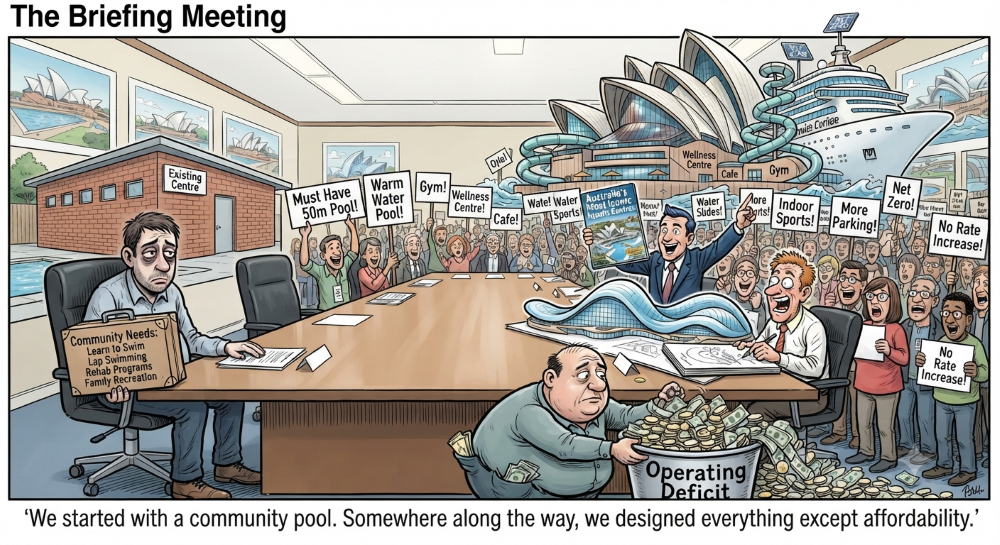
Has aquatic design become better at adding complexity than removing it?
August 2026
If we're serious about making aquatic centres more affordable, perhaps we need to get serious about aligning the outcome to support a robust operational model.
The best projects aren't the ones with the longest list of features. They're the ones where councils, architects, engineers, operators and project managers work together to challenge assumptions, remove complexity and focus investment where it delivers genuine value.
Every additional space, system, plant item and architectural flourish comes with a capital cost, an operational cost and a maintenance burden.
Good design isn't about adding more. It's about achieving more with less.
Yet over the last decade, many aquatic centres seem to have become increasingly bloated with add-ons in the pursuit of financial sustainability.
- Health and wellbeing hubs.
- Medical and allied health consulting rooms.
- Commercial tenancies.
- Hospitality offerings.
- Additional community spaces.
On paper, each inclusion appears to strengthen the business case. But are we creating financially sustainable facilities, or simply building larger, more complex and more expensive facilities that cost more to build and more to operate?
Have we reached a point where the pursuit of additional revenue streams is actually undermining affordability, ill-conceived wish lists, or both?
What's stopping us building simpler, more modest centres?
- Inadequate business models
- Failure to engage with operators early?
- Political expectations and interference?
- Community wish lists and expectations?
- Fear of saying no?
- Risk aversion?
- Reluctance to challenge the brief?
Project teams need to understand and assess the obstacles preventing delivery of genuinely simpler aquatic facilities that are affordable to build, affordable to operate whilst being fit for purpose.
Is Your Swim School Ready for the Next Generation of Energy Efficiency?
July 2026
Thermal Batteries Can Transform Operating Costs
Rather than producing heat exactly when it is needed, thermal batteries allow facilities to store thermal energy when conditions are most favourable and use it later when demand is highest.
This can:
- Reduce reliance on expensive peak electricity.
- Improve heat pump efficiency.
- Increase utilisation of onsite solar generation.
- Provide resilience during cold weather events.
Pool Hall Conditions Matter More Than Many Operators Realise
Small changes in humidity control, ventilation strategy, air temperatures, and pool-cover performance can have a significant impact on overall energy consumption.
In many facilities, the largest savings opportunities are not always where operators expect them to be.
Solar and Heat Pumps Are Most Effective When Designed Together
A rooftop solar system alone may not deliver maximum benefit. When integrated with thermal storage and intelligent controls, solar generation can be used far more effectively to offset heating loads throughout the day and night.
Building Performance Is Critical
The analysis confirmed that insulation levels, glazing performance, airtightness, ventilation heat recovery, and pool-cover effectiveness all have a direct influence on the size of plant required and long-term operating costs.
In some cases, improving the building envelope can reduce the required heating infrastructure and thermal storage capacity significantly.
Refrigerant Selection Is Becoming Increasingly Important
With Australia's ongoing refrigerant transition and increasing focus on sustainability, selecting low-global-warming-potential refrigerants can improve future compliance, reduce environmental impact, and enhance long-term asset value.
Every Facility Is Different
While industry benchmarks are useful, no two swim schools operate the same way.
Factors such as:
- Class schedules
- Patron numbers
- Climate conditions
- Existing plant performance
- Building construction
- Available roof space
- Utility tariffs
can dramatically alter the optimal solution.
A thermal battery that is ideal for one facility may be oversized, undersized, or uneconomic for another.
Thinking About a New Facility or Retrofit?
Whether you're planning a new swim school, upgrading an existing facility, investigating heat pumps, or considering solar and thermal storage, a detailed engineering assessment can identify the most cost-effective pathway and avoid expensive design mistakes.
Modular Aquatic Centres: Promise, Practice, and the Path Through Regulatory Barriers
January 2026
Australia’s aquatic centres are at a crossroads. With 40% of public pools set to be obsolete by 2030 and an $8 billion replacement bill looming, modular and prefabricated construction is emerging as a compelling solution for rapid, cost-effective delivery. But as recent seminars and research show, the journey from concept to completion is far from straightforward.
Modular Pools: Fast, Flexible, and Scalable
The modular “pattern book” approach, championed by Royal Life Saving, offers councils the ability to tailor pool size, depth, and amenities, with delivery times as short as eight months and costs up to 50% lower than traditional builds. This flexibility is especially valuable for regional and remote communities, where skilled trades are scarce and budgets tight.
The Non-Negotiables: Envelope and Mechanical Services
Regardless of delivery method, the fundamentals of aquatic centre performance remain unchanged:
- Building Envelope: High-performance insulation and glazing (“create the Esky”) are essential for energy efficiency, comfort, and operational savings. Poor envelope design leads to excessive heat loss, higher running costs, and larger, more expensive plant equipment.
- Mechanical Services: Modern HVAC, dehumidification, and heat recovery systems must be designed for airtight, well-insulated spaces. Electrification is critical for decarbonization, but must be planned holistically—simply swapping boilers for heat pumps is not enough.
Barriers to Modular Adoption: What’s Holding Us Back?
Despite the promise, modular aquatic centres face significant regulatory and practical hurdles:
1. Regulatory Ambiguity and Fragmentation
- Codes and Standards: Australia’s National Construction Code (NCC) and most design standards are written for conventional, on-site construction. There is no clear recognition of modular and prefabricated methods, leading to uncertainty and delays in approvals.
- Definitions: Inconsistent terminology (e.g., “modular,” “prefab,” “kit home”) across states and councils creates confusion about what is permitted and how approvals are managed.
- Planning Approvals: Local governments often hesitate to approve modular designs, especially in metropolitan areas, resulting in protracted approval times and uncertainty for developers.
2. Compliance and Quality Assurance
- Inspection Challenges: Prefabricated components, especially enclosed modules, are difficult to inspect on-site. There is a need for robust factory certification and third-party quality assurance schemes, as seen in Japan, Sweden, and New Zealand.
- Product Conformity: Current systems (e.g., CodeMark) are not always equipped to handle innovative modular products, leading to slow and costly approval processes.
3. Finance and Contractual Issues
- Progress Payments: Traditional staged payments based on on-site milestones do not suit modular builds, where most work is completed off-site. This creates challenges for financing and insurance.
4. Skills, Familiarity, and Incentives
- Industry Capability: Many builders, certifiers, and regulators lack experience with modular methods. There is a clear need for education, upskilling, and government incentives to drive adoption.
What Needs to Change?
Recent research and industry consultation point to several key recommendations:
- Explicit Recognition: Modular and prefabricated construction should be formally recognized in the NCC, with standardized definitions and dedicated sections or protocols.
- Updated Standards: Develop Australian Standards specifically for modular construction, addressing unique design, transport, installation, and compliance challenges.
- Streamlined Approvals: Create clear, nationally consistent pathways for planning and building approvals, including robust factory certification and third-party quality assurance.
- Financial Reform: Adapt finance and insurance models to suit the realities of off-site construction.
- Education and Incentives: Upskill the industry and provide government support to encourage modular adoption.
Conclusion: Best Practice is Still Best Practice
Modular aquatic centres offer speed, flexibility, and cost savings, but only if the fundamentals are right. A high-performance building envelope and correctly designed mechanical services are paramount for best practice, sustainability, and financial viability. Overcoming regulatory and practical barriers will require coordinated action from government, industry, and the design community.
References:
- Julie Power, “Australia has an $8 billion public pool problem. Is this the solution?” Sydney Morning Herald, Nov 22, 2025.
- “Renewal and New Horizons: Aquatic Centre Seminar,” Negawatt Projects, Kingspan, Compord, July 2025.
- Swinburne University of Technology, HIA, AMGC, “Regulatory barriers associated with prefabricated and modular construction: Final Report, Oct 2022”.
- Australian Building Codes Board: Prefabricated, Modular and Offsite Construction.
- Desklib: Australia Modular Construction.
Renewal and New Horizons: Rethinking the Future of Aquatic Centres
Conference Presentation Overview July 2025
Rising energy costs, ageing facilities, decarbonisation targets, and growing community expectations are forcing councils and operators to rethink how aquatic centres are planned, designed, upgraded and operated. These challenges formed the focus of the Renewal and New Horizons Presentation, which brought together industry leaders, operators, engineers, sustainability experts and designers to explore practical pathways toward more efficient and financially sustainable aquatic facilities.
The Reality: Aquatic Centres Are Energy-Intensive Buildings
Unlike most building types, aquatic centres must maintain large volumes of heated water, warm air temperatures, controlled humidity levels and continuous ventilation. This unique combination makes them among the most energy-intensive facilities owned by local government.
Presenters highlighted that many existing facilities were designed during an era of relatively cheap gas, with limited consideration given to long-term operational efficiency or future electrification. As gas prices rise and carbon reduction targets become more demanding, the industry is now being forced to rethink traditional approaches.
Benchmarking Matters
A recurring theme throughout the seminar was the importance of measuring performance before prescribing solutions.
Energy Use Intensity (EUI) benchmarking was identified as a critical tool for understanding whether a facility is performing efficiently. Research presented during the seminar suggested typical aquatic centres consume around 1,410 kWh/m² annually, while best-practice facilities can perform significantly better.
Without benchmarking and building performance modelling, many facilities risk investing in upgrades without understanding where the greatest opportunities for improvement actually exist.
The Building Envelope: The Biggest Missed Opportunity?
One of the strongest messages of the day was that reducing energy demand should come before increasing plant capacity.
Architect Michael Cook, described this concept as creating an "Esky" around the building. Better insulation, high-performance glazing, airtight construction and thermal bridge reduction can dramatically reduce energy demand before any mechanical upgrades are considered.
Examples presented demonstrated:
- Single glazing can lose heat approximately 2.7 times faster than equivalent double glazing.
- Typical single-glazed windows can lose heat over 30 times faster than high-performance insulated wall systems.
- Improved envelopes can significantly reduce plant sizes, capital costs and long-term operational expenditure.
The message was simple: reducing heat loss is often the most cost-effective energy-saving measure available.
Real-World Results Are Already Being Achieved
The seminar moved beyond theory and showcased evidence from facility operators who are already delivering impressive results.
Paul Sadler Swimland presented examples where targeted investments in insulation, electrification, solar generation and operational improvements achieved:
- Up to 60% reductions in gas usage
- Approximately 50% reductions in electricity consumption through solar generation
- Around 50% reductions in overall energy costs
- Improved occupant comfort and indoor air quality
These examples reinforce that substantial performance improvements are possible when upgrades are strategically planned and implemented.
Electrification Is More Complex Than Many Expect
While heat pumps are often viewed as the future of aquatic centre heating, several presenters stressed that electrification is not as simple as replacing a gas boiler with a heat pump.
Successful conversions require careful consideration of:
- Available electrical capacity
- Site transformers and switchboards
- Space requirements
- Existing heating infrastructure
- Water temperatures and heat exchanger performance
- Operational impacts during construction
This reinforces the importance of developing an evidence-based roadmap rather than pursuing isolated technology upgrades.
Funding Opportunities Continue to Emerge
The seminar also explored grant funding and rebate opportunities available to support facility upgrades.
Several Victorian aquatic projects have already secured significant support through the Community Electrification for Urban Futures (CEUF) program and Victorian Energy Upgrades (VEU) framework. Presenters demonstrated that properly structured projects can unlock substantial rebates, helping councils and operators improve project viability while accelerating decarbonisation outcomes.
The Biggest Lesson? Start With a Strategy
Perhaps the most important takeaway from the seminar was that successful aquatic centre upgrades require a holistic approach.
Facilities that achieve the best outcomes do not begin with a piece of equipment. They begin with:
- Clear performance targets
- Robust business cases
- Reliable operational and energy data
- Appropriate benchmarking
- Integrated design thinking
- Experienced specialist consultants
- A staged implementation roadmap
This approach reduces risk, avoids costly mistakes and creates a pathway toward long-term operational sustainability.
Thanks to our co-presenters:
- John Harbison | Eureka Hydro / Eureka Hydrologic
- Alan Pears AM | RMIT, A2EP, EEC
- Jonathan Duverge | Northern Environmental Design
- Mark Cecil | Paul Sadler Swimland
- Michael Cook | InsightECO
- Dell Larmour | Living Design Double Glazing
- Kaz Nowakowski | Magnetite
- Gary Worrell | Kingspan Insulated Panels
- Stephen Cuthbert | Compord
- Tony Kimpton | TK Thermal / Refrigeration Engineer
- Michael Vaughan | ASAP Scaffold
- Simon Brooks | Former Councillor & Mayor, Mornington Peninsula Shire Council
- Derek Harbison | Negawatt Projects
- Nicklas Lindewald | Metimur Energy
Achieving Net Zero in Aquatic Assets: The Importance of Building Envelopes
December 2022
Councils aiming for net zero emissions by 2050 should consider prioritizing the building envelope in their efforts to reduce carbon footprints in aquatic assets. While upgrading plant technology is important, it is only half the solution. Building envelopes, including insulation, glazing, airtightness, and thermal bridging, offer compounding benefits.
read more...
Councils have focused largely on plant upgrades alone, partly due to the availability of grants, rebates, and capital deferring options. However, reducing energy demand through efficient building envelopes can drive down capital expenditure by decreasing the size of the required plant.
Additionally, lower operating costs can lead to budget neutrality, returning funds for programs, stabilizing entry costs, or lowering council overheads.
Aquatic assets have disproportionately high carbon footprints due to their 24/7 operation and high internal operating temperatures. Glazing and skylights release heat much faster than walls and roofs, respectively, and even insulated walls consume over 30% more energy to keep warm than high-performance walls. Dr. Jean Jonathan Duverge's 2019 study shows that some aquatic centres consume 3.5 times more energy for every metre of floor space than more energy-efficient counterparts.
Combining plant upgrades with general refurbishments, such as retrofitting building envelopes, can bring significant health and wellbeing benefits for staff and patrons. Upgraded air quality, improved circulation, temperature comfort, and reduced odours are some of the benefits.
InsightECO specializes in aquatic centre design and refurbishment, offering cutting-edge innovations and retrofit solutions. Retrofit options can be undertaken while the centre is operating, and most result in a set-and-forget or low-maintenance outcome. With the drive for net zero, councils should seek aquatic centre design specialists to assess specific needs and challenges, recommend tailored solutions, and model the savings. InsightECO is a leading-edge firm in this field, with our Principal being involved in delivery of projects including the Fit2Swim aquatic centre in Maroubra, NSW, which receives a power credit each quarter following installation of solar, Swimland Carrum Downs receiving the ASSA Sustainability Award for 2023 and Swimland Narre Warren receiving an honourable mention in the sustainability category for Australian Tidy Towns. The Fit2Swim swim school outperforms the best-practice benchmark by about eight times at 78 vs. 648 kWh/m2/annum.
The building envelope should not be excluded in the drive for net zero emissions in aquatic assets.
Upgrading plant technology is only half the opportunity, and retrofitting building envelopes can bring compounding benefits that reduce energy demand, decrease capital expenditure, and improve health and well-being. With the right specialist advice, councils can achieve their net zero goals and deliver superior sustainability of their aquatic assets.